Engineering teams are no longer bottlenecked by syntax generation; they are bottlenecked by maintenance. Artificial intelligence has fundamentally inverted the software development lifecycle. Today, generating a functional script takes seconds, but untangling the resulting spaghetti code six months later can take weeks. When technical debt accrues at the speed of an API call, identifying the best LLM for clean code is no longer an academic debate, it is a mandatory operational requirement for modern tech brands.
Writing code that simply compiles and executes is the absolute baseline. Writing code that a human engineer can safely read, debug, and scale requires strict adherence to modularity, error handling, and the SOLID principles.
At Engineers Clinic, we do not evaluate tools based on hype. To definitively settle the debate on the best LLM for clean code, we ran a standardized, highly practical test across the industry’s top AI models. We bypassed generic algorithm challenges (like reversing a linked list) and focused on a real-world enterprise scenario: building an automated, resilient API integration service.
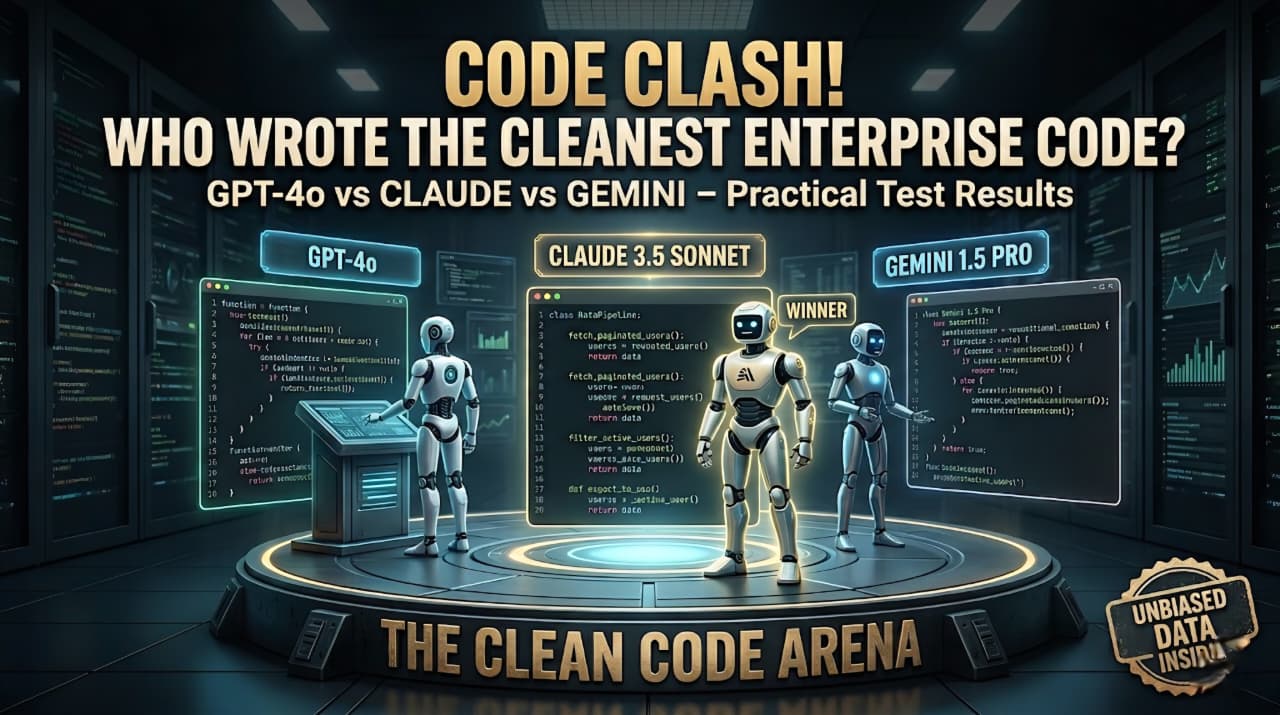
In this deep dive, we will break down the outputs from GPT-4o, Claude 3.5 Sonnet, and Gemini 1.5 Pro to see which model truly understands software architecture.
The Hidden Cost of Dirty AI Code
Before we declare a winner, we must define the metrics. Why does the best LLM for clean code matter so much to the bottom line?
When junior developers rely heavily on standard AI prompts, the resulting output often suffers from what we call “Monolithic AI Syndrome.” The model successfully solves the problem, but it dumps every piece of logic network requests, data transformation, database connections, and logging into a single, massive function.
If an organization scales this bad habit, the codebase becomes incredibly brittle. A single change to a data source breaks the entire pipeline. Therefore, when we evaluate the best LLM for clean code, we are strictly looking for models that natively default to the following principles:
-
Separation of Concerns (Modularity): Does the model isolate distinct business logic into separate, testable functions, or does it tightly couple the operations?
-
Defensive Programming: Does it blindly assume the “happy path,” or does it implement precise
try/exceptblocks, anticipating specific network timeouts and payload failures? -
Naming Conventions: Are variables and functions explicitly descriptive (
filter_inactive_users()), or lazy (process_data())? -
Maintainability (Cyclomatic Complexity): Is the code highly nested with multiple
if/elsebranches, or does it utilize early returns and guard clauses to keep the execution path flat and readable?
The Practical Enterprise Test Setup
To rigorously determine the best LLM for clean code, our test prompt had to mirror a daily engineering task. We tasked the models with a common back-end operational workflow in Python.
Our Prompt:
“Write a Python script that ingests a paginated JSON payload from a REST API webhook. The payload contains user data. The script must validate the payload, filter out any users with an ‘inactive’ status, and upsert the clean records into a PostgreSQL database. Ensure the code is production-ready, handles rate limits gracefully, uses strict type hinting, and follows modern enterprise architecture standards.”
We provided no further architectural guidance. We wanted to see what each model considered “production-ready.” Let us look at how the heavyweights performed in the race for the best LLM for clean code.
Contender 1: GPT-4.o (The Brute Force Approach)
OpenAI’s GPT-4o remains the default engine for thousands of development teams worldwide. Its speed, vast training data, and raw problem-solving capabilities are undeniable. But does it qualify as the best LLM for clean code?
The Output Analysis
GPT-4o immediately reached for the standard requests and psycopg2 libraries. It implemented a standard while loop for the API pagination and successfully utilized Python type hints. It solved the problem exactly as asked.
However, from an architectural standpoint, the code was deeply flawed. GPT-4o generated a single function called sync_user_data(). Inside this one function, it opened a database connection, initialized the API request, looped through the pagination, ran an if statement to check for inactive users, executed the SQL INSERT command, and closed the connection.
Cleanliness Breakdown
-
Pros: Highly functional, correctly utilized type hints, and included a basic
try/exceptblock for the database commit. -
Cons: Zero separation of concerns. The database logic was tightly coupled with the API fetching logic. If we wanted to change the data source from a REST API to a CSV file later, we would have to rewrite the entire database logic as well. Furthermore, its error handling was generic (catching
Exception as e), which is a major anti-pattern in enterprise environments.
The Verdict: GPT-4o is a powerful utility engine, but it is not natively the best LLM for clean code. It requires heavy, explicit prompting (“Rewrite this using the Repository pattern and separate the network logic”) to produce maintainable architecture.
Contender 2: Claude 3.5 Sonnet (The Architect)
Anthropic’s Claude 3.5 Sonnet has rapidly gained aggressive traction in the senior developer community. It approaches problem-solving with a highly structured, deliberate mindset, which is why many industry veterans already consider it the best LLM for clean code on the market.
The Output Analysis
Claude did not just write a script; it architected a microservice. Without being explicitly told to do so, Claude broke the prompt down into a highly modular, class-based structure.
It created an APIClient class to handle the network requests and pagination. It created a DataProcessor class to validate and filter the inactive users. Finally, it created a DatabaseRepository class to handle the PostgreSQL upserts. It then tied them together with a clean dependency injection pattern inside a main execution block.
Cleanliness Breakdown
-
Pros: Immaculate separation of concerns. Claude implemented the
tenacitylibrary for exponential backoff during rate limits a massive hallmark of true production-ready code. It used early returns (guard clauses) to prevent deep nesting, and its variable naming conventions were textbook perfect. -
Cons: For a very junior developer, the abstraction might seem slightly over-engineered for a “simple script.” However, for enterprise teams, this is exactly what is required.
The Verdict: If your primary metric for the best LLM for clean code is human-readability, architectural foresight, and long-term maintainability, Claude 3.5 Sonnet provides the most superior output with zero initial prompting friction. It intrinsically understands software design principles.
Contender 3: Gemini 1.5 Pro (The Context Heavyweight)
Google’s Gemini 1.5 Pro is famous for its massive context window, making it incredible for analyzing massive legacy codebases. But how does it handle generating a clean script from absolute scratch? Is it a contender for the best LLM for clean code?
The Output Analysis
Gemini generated a highly efficient, fast-executing script. It heavily leveraged Python’s standard library and advanced features, utilizing list comprehensions and generators for the data filtering phase, making the memory footprint of the data processing extremely light.
Cleanliness Breakdown
-
Pros: Extremely performant code. Gemini successfully implemented data validation using
pydanticmodels without being explicitly asked, which is a massive win for data integrity. -
Cons: Gemini’s code was technically brilliant but stylistically terse. It favored dense, advanced Pythonic syntax over verbose, readable structures. Additionally, it suffered from “over-commenting” it wrote comments explaining what basic Python syntax was doing (e.g.,
# loops through the list), rather than explaining the “why” behind the business logic.
The Verdict: Gemini is unmatched for analyzing existing enterprise architecture. If you need to dump a massive, messy repository into a prompt to map out dependencies, it is arguably the best LLM for clean code analysis. However, for generating new, highly readable scripts from scratch, it requires stylistic tuning to prevent dense, overly clever syntax.
How to Prompt for Maintainable Architecture
Finding the best LLM for clean code is only half the battle. Even the smartest AI model will generate legacy code if your prompt is vague. Building a culture of autonomous efficiency requires treating the LLM like a junior developer who needs strict architectural boundaries.
To guarantee high-quality, maintainable output regardless of which model you are using, we highly recommend embedding these constraints into your engineering team’s system prompts:
-
Enforce Strict Modularity: Do not just ask for a script. Append your prompts with: “Break all logic into single-responsibility functions. Decouple the database layer from the business logic layer.”
-
Demand Modern Standards: Force the model to use current best practices: “Use strict type-hinting, Pydantic for data validation, and modern language features.”
-
Control the Documentation: Prevent the AI from cluttering the file with useless text: “Only comment on complex business logic and edge cases. Do not comment on obvious syntax.”
-
Mandate Resilience: Require defensive coding: “Include comprehensive, specific try/catch blocks for all external API calls. Implement early returns (guard clauses) to avoid nested if-statements.”
By utilizing the best LLM for clean code in tandem with strict, architecturally sound prompting, your engineering team can completely bypass the technical debt trap that plagues most AI-assisted workflows.
The Final Verdict
Ultimately, identifying the best LLM for clean code depends slightly on your specific operational constraints, but the data from our practical test points to a clear winner.
-
Use Gemini 1.5 Pro if you are dumping a massive, undocumented repository into the prompt and need it refactored or mapped out safely.
-
Use GPT-4o if you are rapidly prototyping a minimum viable product and need raw functional logic immediately, knowing you will refactor it later.
-
The Overall Winner: For building maintainable, scalable, and isolated enterprise systems from scratch, Claude 3.5 Sonnet is currently the undisputed best LLM for clean code. It inherently thinks like a senior software architect, building with the next developer in mind.
At Engineers Clinic, we know that beyond finding the best LLM for clean code, the true competitive advantage lies in the engineers who pilot these systems. Our enterprise-grade training infrastructure teaches next-generation talent how to leverage the best LLM for clean code to architect automated, resilient revenue pipelines. Manual engineering is obsolete; the future belongs to those who build the machines that write the code.
Previous Blogs:
The 5-Step Workflow to Automate Jira Tickets with AI
How to Format an ATS Friendly Engineering Resume (That Actually Gets Read)
